Stay Updated with the Latest Insights and Tips
Welcome to our blog page! At 222 Websites, we share valuable content designed to help your business thrive in the digital world. From web design trends to SEO strategies and digital marketing tips, our blog is your go-to resource for staying informed and ahead of the competition.

Boost Visibility: SEO for Small Business Success Without Ads
SEO for Small Businesses in 2026 — Get Found Organically (No Ads Required)
Search in 2026 is shaped by AI summaries, local intent, and more zero‑click answers — yet organic search is still the most cost‑effective way for small businesses to reach ready customers without ongoing ad spend. This guide walks owners through how modern SEO works, the technical and content priorities that drive visibility, and practical steps to win local map packs and AI overviews. You’ll learn why organic search delivers stronger long‑term ROI than ads, which site elements are non‑negotiable, a local SEO playbook for Google Business Profile and citations, and an AI‑first content approach tuned for Google SGE and zero‑click results. Expect clear templates, checklists, and hands‑on steps you can use yourself or hand to an agency.
Why Is SEO a Better Investment Than Paid Ads for Small Businesses in 2026?
SEO builds lasting visibility through relevance and authority; ads vanish the moment the budget stops. Organic search accumulates signals — high‑quality content, backlinks, consistent citations, and user engagement — that compound over time and lower the cost per conversion. AI summaries and zero‑click features make structured, authoritative content even more valuable because extractable answers and proper schema boost branded exposure without paying per click. Below is a concise look at the core advantages to help you prioritize long‑term SEO over short bursts of ad spend.
SEO beats paid ads for small businesses in practical ways:
Durable visibility: Optimized pages keep attracting traffic long after publication.
Lower lifetime cost per lead: Compounding organic traffic reduces acquisition costs over months.
Better intent match: High‑quality organic results convert more effectively for local, commercial searches.
Stronger against AI SERP shifts: Structured content and E‑E‑A‑T increase the chance of being pulled into AI summaries.
These advantages inform decisions about site investment, content systems, and local presence that small businesses should prioritize to capture long‑term value.
What Long‑Term Benefits Does Organic SEO Offer Over Paid Advertising?
Each optimized page can earn traffic for months or years, which reduces dependence on continuous ad spend and lowers the effective cost per customer over time. Organic visibility also builds brand recognition and trust, which improves conversions from calls and appointment bookings. Framing expectations this way helps owners plan technical fixes and content systems that support steady, sustainable growth.
How Does SEO Build Brand Authority and Trust for Small Businesses?
SEO builds authority via repeatable signals: helpful content that answers real questions, third‑party mentions and backlinks, structured data that clarifies what your business does, and aggregated customer reviews that show trust. E‑E‑A‑T — experience, expertise, authoritativeness, trustworthiness — combines case studies and author bios with reputable citations to influence rankings and click behavior. Clear contact details and team bios also turn hesitant searchers into callers and scheduled customers. These elements lead into the practical site foundations every small business should deploy.
What Foundational SEO Elements Does Every Small Business Website Need?
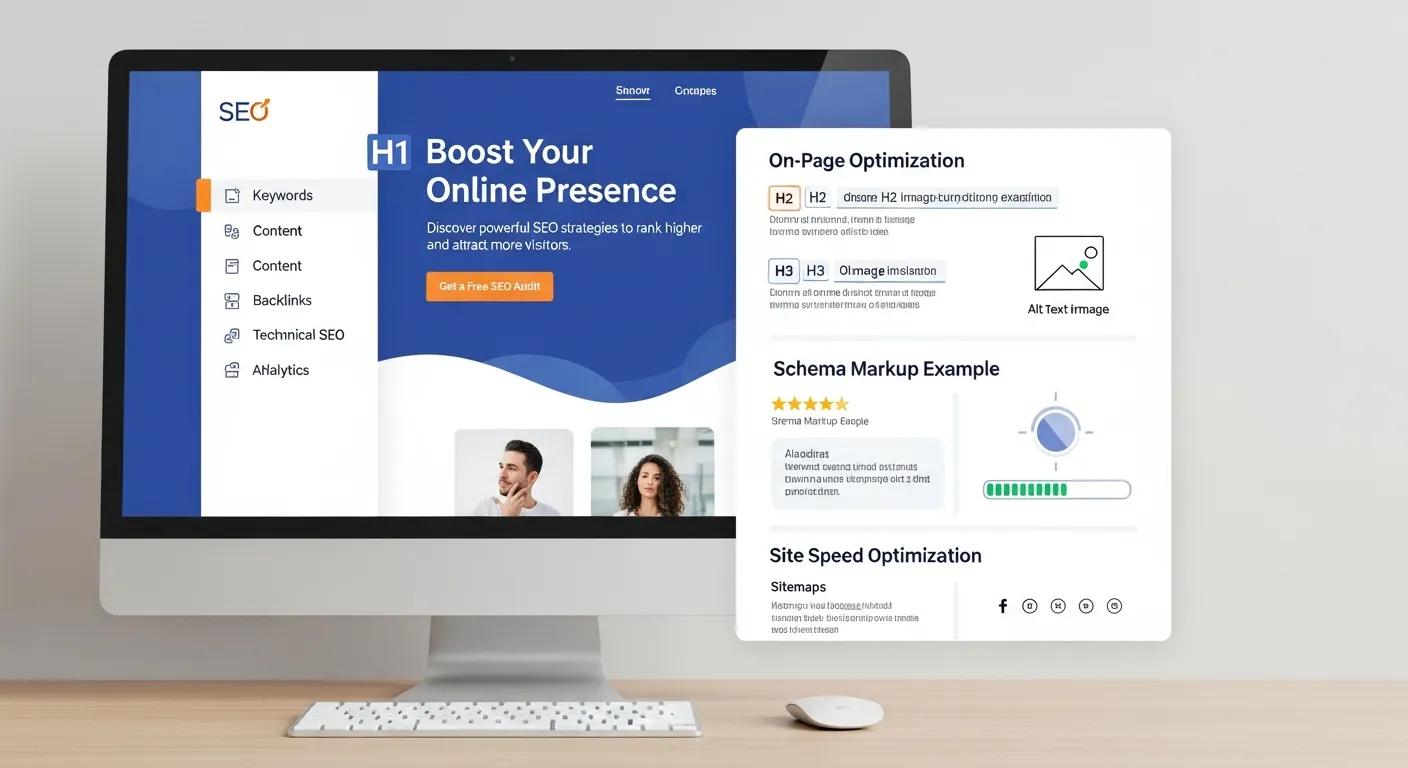
Your website must be technically healthy, locally optimized on‑page, and structured to demonstrate E‑E‑A‑T — the three pillars search engines and AI extractors rely on. Technical SEO covers speed, mobile‑first UX, secure delivery, and crawlability so pages can be indexed reliably. On‑page SEO uses optimized titles, meta descriptions, headings, and local keyword targeting to match intent. Content and trust signals — author bios, case studies, review markup, and LocalBusiness schema — boost authority and increase the chance your content appears in AI summaries and featured snippets.
Before the technical checklist, here’s a compact comparison of core page‑level targets and recommended settings:
This table compares essential technical elements and practical targets to prioritize during an audit.
Page / ResourceMetric / RequirementRecommended TargetHomepage / Landing PageLargest Contentful Paint (LCP)≤ 2.5 seconds on mobileCore Pages (service/location)Cumulative Layout Shift (CLS)≤ 0.10All PagesSecure delivery & crawlabilityHTTPS + robots.txt & sitemap present
This quick reference clarifies where to focus first: speed, layout stability, and secure, indexable pages. Fixing these lets your on‑page and content work pay off.
Once technical health is in place, use a concise on‑page checklist so each page clearly signals local relevance and user intent. The next section explains how to make your site fast and which tools validate progress.
Business integration — practical support: 222 Websites helps small businesses implement these foundations quickly, pairing fast site delivery with ongoing SEO management. Their approach prioritizes rapid design and technical fixes, transparent pricing, and continuous content and performance support to keep sites aligned with search updates. If you need hands‑on execution — web design, Core Web Vitals improvements, or schema setup — this kind of implementation bridges strategy and measurable results. The following on‑page practices show what to expect when a partner executes these items.
How Do You Ensure Your Website Is Mobile‑Friendly and Fast in 2026?
Start with hosting and infrastructure optimized for your audience’s geography, a lightweight theme, and efficient asset delivery via CDNs and modern image formats. Use PageSpeed Insights, Lighthouse, and the Core Web Vitals reports in Google Search Console to spot LCP, CLS, and INP/FID issues and prioritize fixes that yield the biggest gains. Common quick wins: compress images and serve responsive srcset, enable text compression, defer noncritical JavaScript, and avoid large layout‑shifting elements above the fold. A focused performance sprint will improve both metrics and user engagement — outcomes search engines reward.
Which On‑Page SEO Practices Improve Local Search Performance?
Map commercial and informational local keyword variants to specific pages and use them naturally in title tags, H1s, and meta descriptions. Add LocalBusiness schema with address, service areas, hours, and service categories to increase the chance of extraction into AI overviews. Create unique location landing pages and voice‑search friendly FAQs to capture conversational queries. These steps boost map‑pack relevance and prepare content for AI snippets and featured answers.
How Can Small Businesses Master Local SEO to Bring in Qualified Traffic?
Local SEO combines Google Business Profile optimization, consistent citations across directories, proactive review management, and locally focused content to build prominence for geographically qualified searches. The principle is completeness and consistency: a fully optimized GBP, accurate NAP across directories, and content that answers local buyer questions. Local backlinks from community engagement and partnerships also strengthen authority. Below is a practical playbook you can run today to improve local rankings and customer actions.
Research consistently shows that strong foundational SEO and an optimized Google Business Profile are essential for micro‑businesses aiming to grow online.
Local SEO & Google Business Profile Training for Micro Businesses
This community outreach program teaches micro‑business owners how to use Search Engine Optimization (SEO) and Google Business Profile to expand their online reach. Training covers SEO basics, creating discoverable digital content, and step‑by‑step guidance for setting up and maximizing Google Business Profile so businesses appear in Google Search and Maps.
Follow these essential local steps to capture qualified nearby traffic:
Complete your Google Business Profile: Fill every relevant field and pick precise categories that match search intent.
Audit and fix citations: Make sure your name, address, and phone (NAP) are consistent across major and niche directories.
Ask for and respond to reviews: Create a repeatable workflow for review requests and timely, professional responses.
Publish local landing pages: Build pages that answer neighborhood questions and target specific local keywords.
These steps set the stage for measurable local performance; the following sections dig into GBP tactics and citation management.
This table lists priority directories and the NAP fields to standardize during a citation audit.
Directory TypeCritical FieldsAction / TipMajor listings (maps, search profiles)Business name, address, phone, categoriesEnsure exact NAP match and precise category selectionIndustry directoriesServices, description, website linkUse unique, locally relevant descriptions for each directoryLocal portals / chambersContact info, hours, imagesKeep photos current and contact details consistent
Consistent citations reduce confusion for users and search engines, improving map‑pack eligibility and trust signals that feed into E‑E‑A‑T.
Practical implementation support: If you prefer guided execution, 222 Websites offers local SEO services including GBP optimization, citation cleanup, and review workflow setup. Their local focus delivers quick, measurable improvements and ongoing support to keep listings fresh and aligned with algorithm changes — helpful if you want a partner to handle technical citation fixes while you run the business.
What Are Best Practices for Google Business Profile Optimization?
Optimize GBP with precision: choose the most accurate primary category, list your services as structured entries, upload high‑quality photos regularly, and use GBP posts to signal freshness. Prepopulate the Q&A with helpful answers and monitor new questions daily. Track GBP actions — calls, direction requests, website clicks — to measure local performance and refine your messaging. A steady cadence of posts, photos, and review responses keeps your profile competitive in the local pack.
How Do You Build Consistent Local Citations and Manage Reviews Effectively?
Run a citation audit to find inconsistent or duplicate listings, fix major platforms first, then cascade the correct NAP to niche directories and local portals. Create a simple review solicitation process triggered after service completion and provide polite response templates. Add structured review markup on site pages and showcase testimonials on service pages to reinforce trust. A consistent citation and review program produces measurable lifts in local rankings and increases conversion from nearby searchers.
How Do You Implement an AI‑First Content Strategy for Small Business SEO in 2026?

An AI‑first content strategy structures pages so AI systems and search engines can surface short answers and then link to deeper resources, capturing both zero‑click exposure and downstream clicks. Lead pages with a short, authoritative TL;DR, follow with clear bullets, and include linked deep dives for visitors who want more. Use schema for FAQs, Q&A, and HowTo so AI overviews can extract structured responses. The templates below show extractable formats that raise your odds of appearing in AI summaries and featured snippets.
Use these tactics to optimize for AI overviews:
Short answer + bullets: Start with a concise answer (40–60 words), then 3–5 bullets that summarize steps or benefits.
Table templates: Use comparison tables for pricing, features, or checklists to improve extraction and clarity.
FAQ / HowTo schema: Add structured markup for questions and step‑by‑step procedures to boost snippet eligibility.
The table below gives snippet templates and structures you can reuse for service pages and local guides.
Snippet TypeStructureExample / TemplateDefinition1‑sentence answer + 3 bullets"What is X? — One‑sentence answer. • Key point 1 • Key point 2 • Key point 3"Step listShort lead + numbered steps"How to do Y: 1. Step one 2. Step two 3. Next action"ComparisonTwo‑column table"Feature | Benefit — Feature A | Benefit A"
These extractable formats improve AI SERP visibility while keeping on‑site conversion paths intact.
What Is Zero‑Click Search and How Do You Optimize for It?
Zero‑click search happens when the engine answers the query on the results page, removing the need for a click. Even without clicks, visibility builds brand exposure and indirect conversions. To benefit, place a concise, authoritative answer at the top of the page, include subtle branded CTAs inside TL;DR boxes, and ensure structured data is present for extraction. Emphasize your brand and value proposition in the answer so impressions translate into later direct visits, calls, or bookings.
How Should You Structure Content for Google SGE and AI Overviews?
Make pages chunkable: a one‑sentence lead, a 3–5 bullet summary, clearly labeled subsections, and a deep‑dive section with examples and local details. Use headings that match likely user questions and apply FAQ or HowTo schema where relevant. Link internally to supporting resources so AI extractors can trace sources, and keep language concise and authoritative. This layout improves the chance Google SGE and other AI engines will include your content in composite answers.
How Do You Build and Showcase E‑E‑A‑T to Boost Local SEO Authority?
E‑E‑A‑T is best shown through verifiable experience, clear author or team expertise, documented results, and transparent trust signals. Experience appears as detailed service pages and labeled case studies; expertise shows up in author bios linked to verifiable profiles. Authoritativeness grows with reputable local mentions and partnerships, while trust comes from reviews, clear contact options, and published policies. Below are practical practices small businesses can implement to make these signals meaningful for both users and search engines.
Key E‑E‑A‑T building blocks include:
Author and practitioner bios: List credentials and project details to tie content to real expertise.
Case studies with metrics: Show the challenge, your approach, and measurable outcomes.
Structured review and award markup: Apply Review and Award schema where appropriate to surface external validation.
These elements form the basis for templates in the following sections that small businesses can adopt immediately.
How Does Demonstrating Expertise and Experience Improve Rankings?
Showing real expertise and experience boosts user trust and engagement, which signal quality and relevance to search engines. Author bios linked to credentials raise topical authority, while case studies increase dwell time and provide concrete proof of results. Earning external mentions from local partners and using them as citations enhances perceived authority. These are practical steps that lead to measurable ranking improvements.
What Role Do Case Studies, Testimonials, and Awards Play in SEO?
Case studies, testimonials, and awards act as proof‑points that improve conversion and support E‑E‑A‑T when formatted for both people and machines. Use an annotated case study template — challenge, approach, metrics, and visual proof — and add Review or AggregateRating schema to testimonial pages. Present awards with context and structured markup so search engines can connect them to your credibility. Properly formatted proof elements increase engagement and strengthen signals for local and organic ranking systems.
What Are Best Practices for Measuring and Monitoring SEO Success in 2026?
Track a mix of exposure, engagement, and conversion metrics with a cadence that balances monthly checks and quarterly content refreshes. Core KPIs: organic impressions and clicks, click‑through rate (CTR), Google Business Profile actions (calls, directions, website clicks), and conversion rates tied to calls or bookings. Use stacked tools — Google Search Console and GA4 for core metrics, GBP Insights for local actions, plus citation and rank‑tracking tools. A monthly operational review and quarterly content audit keeps your strategy aligned with AI‑driven SERP changes.
Recommended monitoring cadence:
Monthly: GBP actions, citation health, and top keyword changes.
Quarterly: Content pillar refreshes, backlink review, and technical audits.
Annually: Strategic audit for new markets and major site updates.
These intervals balance responsiveness with the time organic initiatives need to produce measurable results.
Which KPIs Should Small Businesses Track for Organic and Local SEO?
Track impressions and clicks for reach, CTR for snippet performance, and GBP actions (calls, direction requests, website clicks) for local conversion. Monitor ranking trends for priority keywords, page‑level engagement (time on page, bounce rate), and event conversions for bookings or contact submissions. Benchmarks vary by industry, but steady increases in impressions and GBP actions reliably indicate progress and help prioritize which pages to optimize next.
What Tools Help Monitor SEO and Adapt to Search Changes?
Use Google Search Console for query insights, GA4 for behavior and conversions, and GBP Insights for local actions. Complement those with crawlers and local SEO platforms for citation and rank monitoring. Lightweight crawlers find technical issues; content audits reveal pages that need consolidation or expansion. Set alerts for sudden drops in impressions or crawl errors and schedule regular audits so you can pivot content and technical work when algorithms or AI SERPs change.
222 Websites offers targeted, ongoing SEO support for small businesses that need fast execution and continuous management. Their services focus on quick site builds, transparent pricing, AI‑informed strategies, local expertise around Charleston, WV, and ongoing support that includes continuous management and unlimited edits. If you’d prefer a partner to handle technical fixes, local SEO, and content while tracking KPIs and adapting to search changes, this support is designed to turn SEO work into measurable calls, messages, and booked appointments.
Frequently Asked Questions
What’s the difference between local SEO and traditional SEO for small businesses?
Local SEO optimizes your online presence to attract customers from nearby searches — think Google Business Profile, citations, and reviews. Traditional SEO aims for broader visibility without a geographic focus. Both matter, but local SEO is essential for businesses that rely on nearby customers because it helps you appear in map packs and local results that drive foot traffic and calls.
How can small businesses manage online reviews effectively?
Effectively managing reviews means asking satisfied customers to leave feedback, responding quickly and professionally to both positive and negative reviews, and keeping a repeatable review‑request process. Use polite templates for responses and add review markup to your site to improve visibility. Regularly monitor platforms to protect your reputation and boost local SEO.
How important is content quality for small business SEO?
Content quality is fundamental. Useful, relevant, and well‑structured content increases engagement, dwell time, and shares — all signals that build authority. For small businesses, focus on content that addresses customer needs and local topics. Use natural keyword placements and formats like FAQs or how‑tos to improve discoverability.
Can social media help with SEO?
Yes. Social media drives traffic to your site, increases brand visibility, and can lead to backlinks from other sites. Social profiles also appear in search results, giving another visibility channel. Post local, helpful content and engage your audience to support your SEO efforts.
What common SEO mistakes should small businesses avoid?
Common errors include ignoring local SEO, neglecting mobile optimization, and failing to update content. Many also skip structured data and schema markup, which help search engines understand your content. Finally, not tracking KPIs means missed improvement opportunities. Run regular audits, update content, and prioritize local SEO to avoid these pitfalls.
How critical is website speed for SEO in 2026?
Website speed is crucial. Fast pages improve user experience and reduce bounce rates — factors search engines prioritize. In 2026, speed remains a major ranking and conversion driver. Regularly test performance with PageSpeed Insights and apply best practices like image compression and efficient code to keep your site fast.

Ready to rank on page one? You need SEO services drive qualified organic traffic to your business.
Need a high-converting website? Explore our professional website design services built to scale your business.
Both services are designed to build your foundation to get found and grow.
Unleash Your Business Brilliance.
Your Online Success Starts Here
© 2026 222 Websites - All Rights Reserved